
Desirability
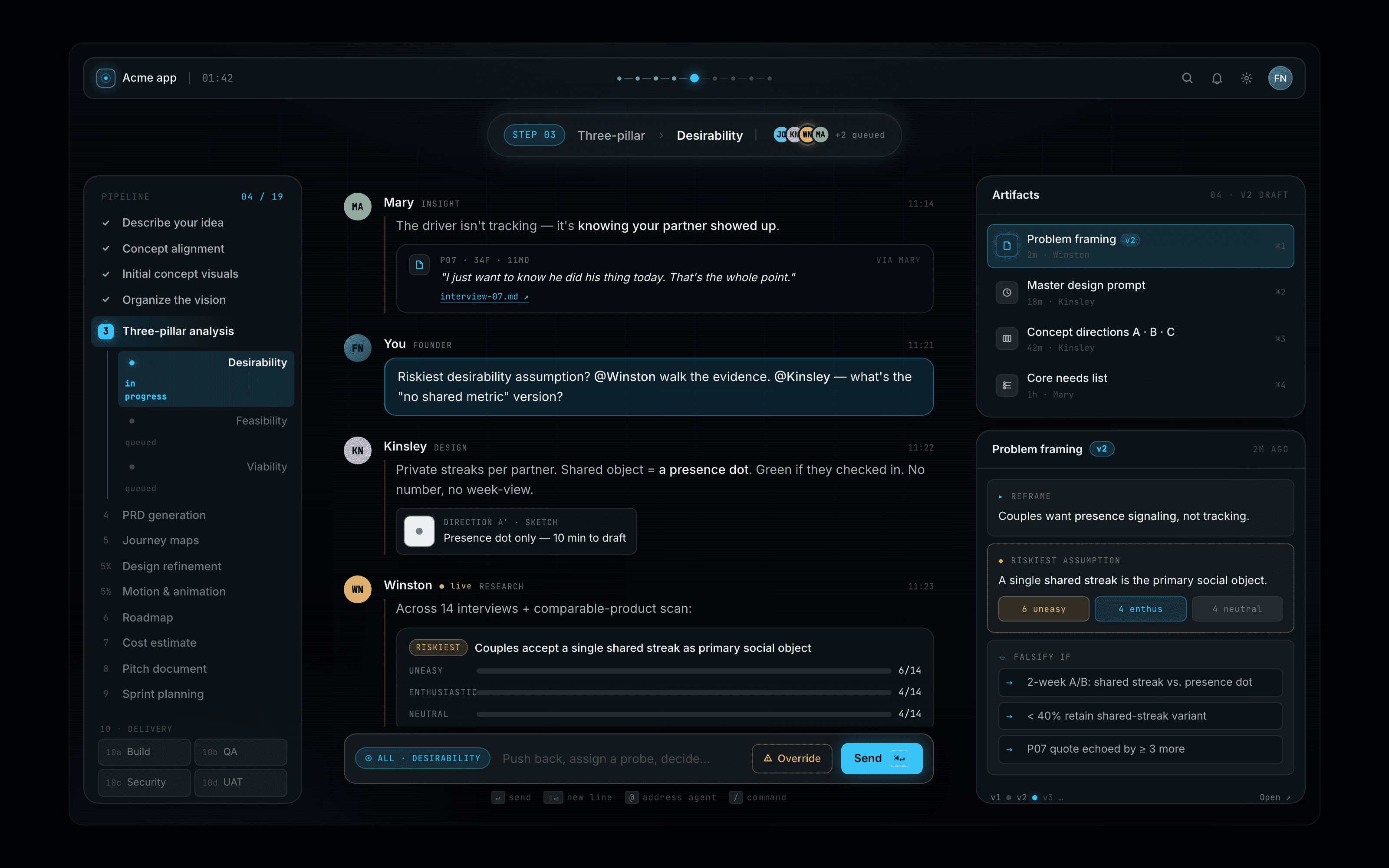
Do people actually want this?
Your research and design-thinking agents run the discovery, surface the need, and test the shape of the problem before you commit to a solution.
Quorum Plus · Self sign-up
, each with their own role, tools, and memory.
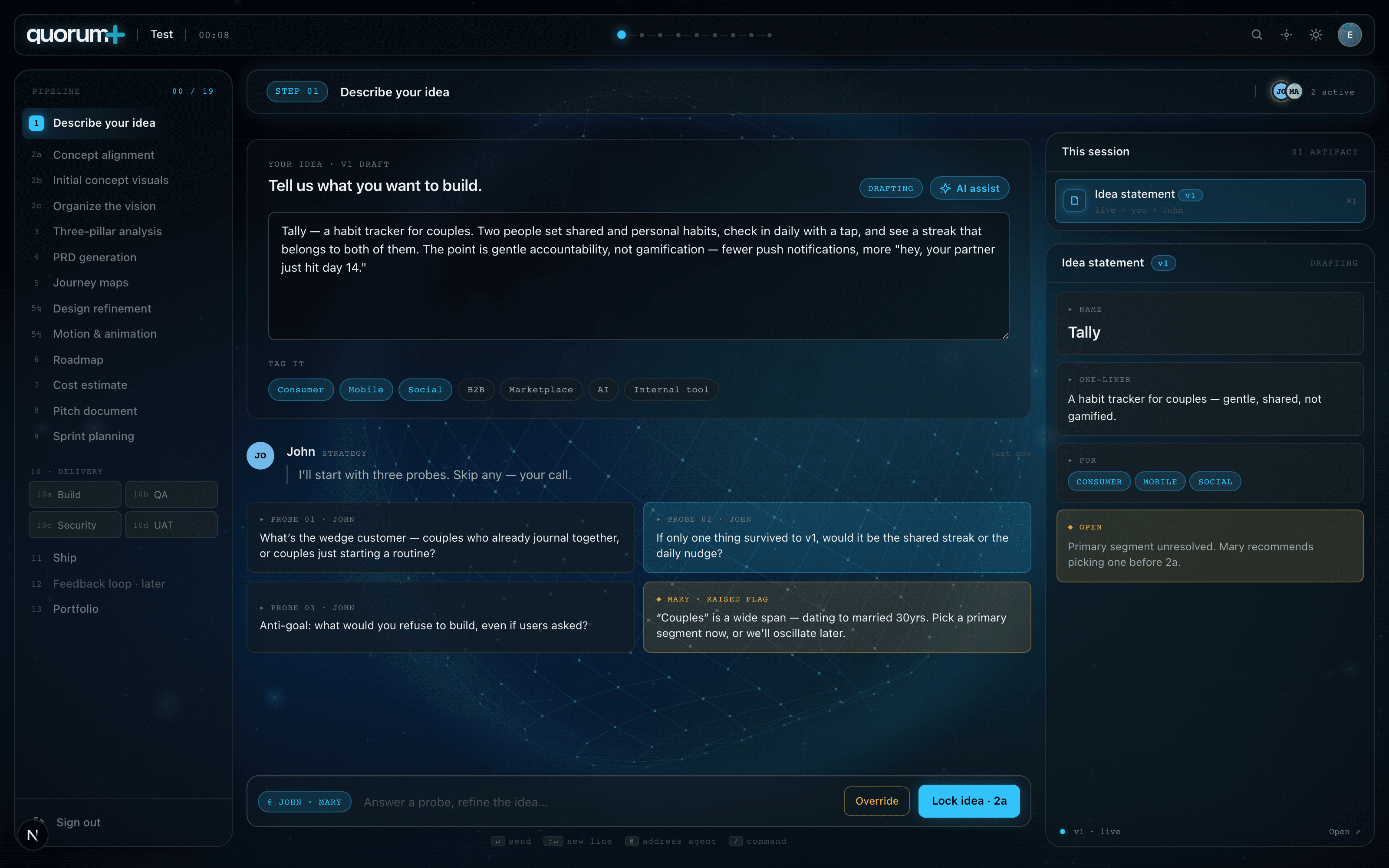
No signup required. Pre-filled work shows you what Quorum actually does.
What you get
Most products give you tools. Quorum gives you a team: twenty-one agents, one workspace, and every artifact ready to export.
PM, designer, dev, QA, security, and sixteen more. AI agents for every role you don't have yet. They work in parallel when they can, hand off cleanly when they can't. You set direction. They fill in.
Discovery, design, PRD, stories, QA, release. The whole pipeline in one place, not seven tools. Every artifact links back to the stage that produced it. Every decision has a paper trail.
Concept mockups, journey maps, design prompts. Your product takes shape on screen before code. Review the flow, the layout, the tone. Change what feels off. Only then does anyone start building.
PRDs, stories, design specs, case studies, portfolio pieces, pitch decks. All export to HTML, DOCX, and PDF. Output bends to your project: tone, headings, even the cover page. Just tell the agents what you want.
Methodology
Most frameworks ask you to narrow early. Quorum flips it: every idea starts on the table, then three filters decide what ships.
Do people actually want this?
Your research and design-thinking agents run the discovery, surface the need, and test the shape of the problem before you commit to a solution.
Can it actually be built?
Your architect and dev agents model the system, flag the hard parts, and scope the build before a sprint starts.
Does it make business sense?
Your PM and strategy agents check market fit, cost, and alignment. If it doesn't ladder to a business, the filter catches it.
The ideas that pass all three earn a PRD. The rest get retired early, before they cost you a sprint.
How it works
Your agents own each stage end to end. No managers, no leads. Each role handles its section alone and hands off to the next.
Frame the problem. Research the domain. Interview the audience. Decide what's worth building before a line of code is written.
Meet the team
Mary, Carson, Maya, Victor, Sophia, Paul
PRD, user flows, visual design, motion. Your product takes shape on screen before code. Change what feels off. Lock the good parts.
Meet the team
John, Kinsley, Luca, Paige
Architecture, frontend, backend, stories. Broken down and executed in order with acceptance criteria as the bar.
Meet the team
Winston, Bob, Amelia, Barry, Damien, Jaymes
QA, security review, content polish, release. Plus the case studies, portfolio pieces, and pitch decks you need for launch. All exported and ready to send.
Meet the team
Quinn, Murat, Cipher, Quentin, Caravaggio
Your part
The team runs the pipeline. Your side stays simple: four steps from a first sentence to a product you can launch.
Tell the team what you want to build in plain language. No briefs, no jargon. A sentence or two is enough to begin.
Your agents research, scope, and design while you follow along. The PRD, user flows, and specs fill in on screen, not after a long silence.
Review each milestone, change what feels off, and lock what works. You also set how much the team explains, from a full walkthrough to a quiet build.
Leave with the working build, every artifact, and a branded planning site. Host it anywhere. Nothing stays locked inside Quorum.
How it teaches
Not every founder is a developer. Not every developer is a backend expert. Set the dial to match your skill and the team adjusts.
I'm new to this. Walk me through it.
Every step explained. Nothing assumed. Your agents teach the why behind each decision and show their work as they build.
New to the stack. First product. Learning as you go.
I know the basics. Check in on the hard parts.
Agents handle familiar work, surface the tricky decisions, and explain only the parts you need context on.
Shipped before. Comfortable with the stack. Saving cycles.
I trust the process. Just ship it.
Agents work independently across the pipeline. You review milestones and approve the major calls.
Experienced. Time-boxed. Shipping iteratively.
Plus: web research when context runs out, backend setups walked through step by step, and complicated scenarios explained in plain language. When an agent learns something new, it shows you the source.
Your team
Four of your twenty-one agents: a designer, a backend dev, a security specialist, and a content strategist. The rest are one click away.
Product Designer
Owns end-to-end design: research, interaction, visual, design systems, information architecture, accessibility, and design QA.
Backend Developer
Builds backend, APIs, auth, databases, and deployment. Explains the WHY behind every choice; teaches as he builds.
Offensive Security Specialist
Hunts vulnerabilities like an attacker before release. Demonstrates exploits, fixes root causes, verifies the patches.
Content Strategist
Owns voice, tone, user-facing copy, content accessibility (WCAG / ADA), and cross-layer product diagnosis.
From early builders
Solo founders, first time builders, and freelancers using Quorum Plus to take an idea all the way to a live product. Sample voices shown.
I shipped my first real product in a weekend. The agents handled the parts I always got stuck on and explained the rest, so I actually learned something along the way.
It feels less like a chatbot and more like a studio that remembers what we decided last week. The handoffs between roles just work, with nothing dropped between them.
I came in with zero backend experience. Damien walked me through the database setup step by step, and I ended up with a live URL instead of a pile of code I could not run.
The exported PRD and case study landed me two client calls. Having real artifacts to hand over made a one person studio look completely buttoned up.
Quorum Plus travels with you.
Support
Quorum is a workspace where a team of twenty-one specialized AI agents takes your idea from first sketch to shipped product. They handle research, PRDs, design, architecture, build, QA, security, and release while you steer the direction. Think of it as a full product studio that runs on your own projects and works the way you do.
No. Quorum Plus is twenty-one specialized agents with distinct roles, tools, and memory. Each one owns a part of the process: research and PRDs, design, architecture, build, QA, security, and release. They remember your project context across sessions. A single chat window can't do that.
Solo Free is $0 and runs one workspace with core ideation, PRDs, and HTML exports. Solo Pro is $30 a month, or $28 a month billed annually, and unlocks unlimited workspaces, the full design-to-release pipeline, and every export format. Teams start at $50 per user each month. You pick a plan when you create your account.
Yes. The demo is open to everyone, with no account needed. It is pre-filled with real project work so you can click through what the agents actually produce. Use Try our demo at the top of this page, then create a free account whenever you are ready.
The web app is live today, so you can start free right now. Native iOS and Android apps are on the way; you can spot the App Store and Google Play badges further down this page. We will switch them live the moment the apps ship.
Yes. Every artifact your agents produce exports to HTML, DOCX, and PDF: PRDs, user stories, design specs, architecture docs. We also publish a complete planning site for your project: the PRD, architecture, the case study, change log, sprint status, and portfolio piece, all one branded micro-site you can host anywhere. No lock-in. If you leave Quorum Plus, you keep every artifact you built here.
Yes. The build agents pick a stack that fits your project (Damien recommends backend, Otis picks hosting, Winston validates the database choice), then run the setup for you: domain registration, hosting deploy, database provisioning, environment variables, secrets, monitoring. You get a live URL at the end of the pipeline, not a code dump.
No. Your agents explain their reasoning and teach as they go. Damien narrates backend decisions, Kinsley walks through design choices, Jaymes shows you how frontend work comes together. You steer the product direction. They handle execution.
Yes. Upgrade, downgrade, or cancel any time from your account settings. Downgrading keeps your existing work accessible. Cancellation preserves read access to your exports, so you keep using what you already built.
Solo Free runs one workspace with one active pipeline. Solo Pro and every team plan run unlimited workspaces and unlimited pipelines in parallel. Run three products at the same time if that's how you work.
Solo Free gets community support through forums and docs. Solo Pro adds direct email support. Team Starter inherits Pro support. Team Business adds priority response times for urgent issues.